
Three letters, one number, and a surprising amount of anxiety. You’ve probably seen your BMI on a chart at a clinic, in a fitness app, or on a workplace health form — and maybe it put you in a box labeled “overweight” that didn’t feel right at all.
Here’s the honest version: what BMI actually measures, what the categories mean in plain words, and the important things it can’t tell you. This is general information to help you understand the number — it’s not medical advice, and if you have questions about your own health, talk to a professional.
What BMI actually is — in 30 seconds
BMI stands for Body Mass Index. It’s a single formula that compares your weight to your height:
BMI = weight in kilograms ÷ (height in metres × height in metres)
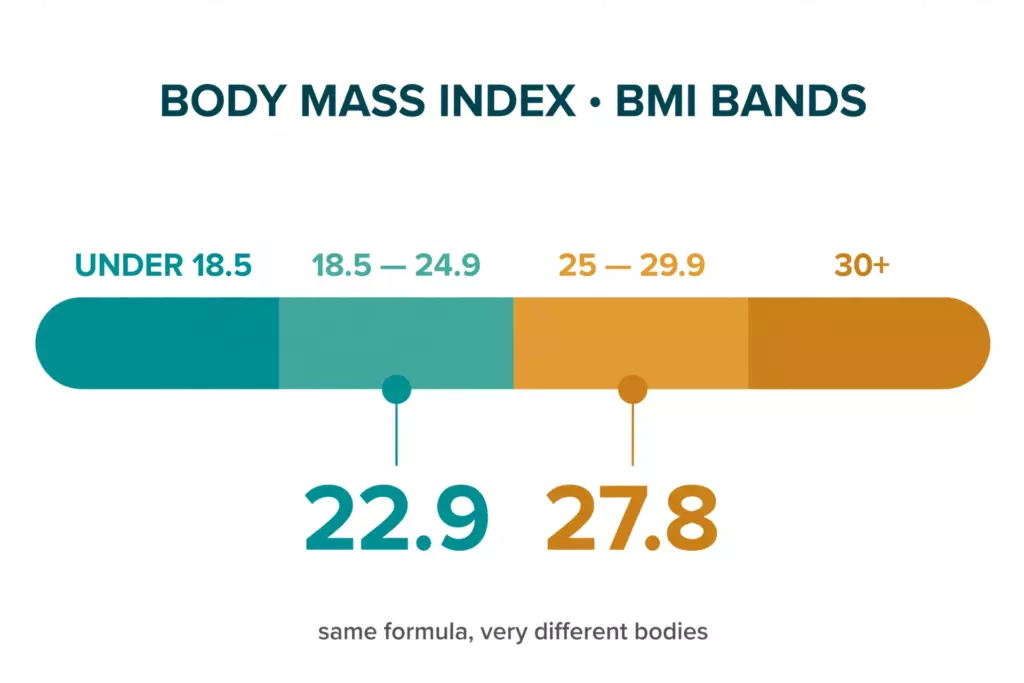
That’s it. One division, done twice. Take someone who weighs 70 kg and is 1.75 m tall: 1.75 × 1.75 = 3.0625, and 70 ÷ 3.0625 = 22.9.
A bit of honest context: this formula wasn’t invented by a doctor studying health. It was created in the 1830s by a Belgian mathematician, Adolphe Quetelet, who was looking for the “average man” for statistics — not diagnosing patients. Doctors adopted it much later because it’s cheap and quick: no equipment, no lab, just a scale and a tape measure.
The categories, in plain words
Health organizations (notably the WHO) group BMI results into four broad bands. Here’s what they are, without the scare tactics:
- Below 18.5 — underweight. The formula says there’s relatively little body mass for the height.
- 18.5 to 24.9 — “healthy” range. This is the band associated, on average, with the lowest health risks across large populations.
- 25 to 29.9 — overweight. Above the middle band. A flag for a conversation, not a diagnosis.
- 30 and above — obesity. The band where population studies show health risks climbing more steeply.
Two things worth noticing. First, these are ranges, and a 24.8 and a 25.1 are practically the same body — the line between them is administrative, not biological. Second, every one of these bands describes populations, not you personally. “People in this range tend to…” is very different from “you are…”
What BMI is actually good for
Let’s be fair to it — BMI survives because it does a few things well:
- It’s a cheap first screen. A nurse can calculate it in ten seconds during a checkup and decide whether a deeper conversation is worth having.
- It works reasonably at population level. Across thousands of people, higher average BMI tracks with higher rates of certain conditions. Public-health researchers genuinely use it.
- It gives you a starting point. One number, tracked over years, can show a trend — even if the number itself is rough.
Think of it like a smoke alarm: useful for flagging that something might deserve attention, useless for telling you what’s actually happening.
What it can’t tell you — the honest part
This is the part most articles skip, and it’s the most important.
It can’t tell muscle from fat. This is the big one. Muscle is denser than fat, so a fit, muscular person can score “overweight” without carrying excess fat at all. Example: someone 1.85 m tall weighing 95 kg, built like a rugby player — BMI = 95 ÷ (1.85 × 1.85) = 95 ÷ 3.4225 = 27.8, landing in the “overweight” band. The formula sees the weight; it has no idea the weight is muscle.
It can’t see where fat sits. Research consistently shows that fat around the midsection is more strongly linked to health risks than fat on the hips and thighs — but BMI treats all weight identically wherever it lives.
It ignores age and sex. The same formula and the same cutoffs are applied to a 25-year-old man and a 70-year-old woman, even though bodies change with age (muscle mass naturally declines) and differ between sexes. Older adults and women can be misread in both directions.
It’s weaker for some groups entirely. It’s not designed for children (they use age-adjusted percentile charts instead), it’s misleading for pregnant women, and it’s a poor tool for very muscular or very frail people.
It says nothing about your actual habits. It doesn’t know if you walk daily or never move, whether you sleep well, what you eat, or how stressed you are — all of which matter enormously for health and none of which fit in a division sum.
So should you care about your number?
Here’s a balanced way to think about it: BMI is one data point, not a verdict. If your number sits comfortably in the middle range and you feel fine, there’s nothing to do. If it’s very high or very low and that’s new, or you’re concerned about it, that’s a reasonable prompt to talk to a doctor or nurse — not because the number diagnosed anything, but because a professional can look at the whole picture the formula can’t see.
What you shouldn’t do: crash-diet because a chart put you 0.3 over a line, or ignore real symptoms because your BMI looks “fine.” The number is a rough guide. You are not a rough guide.
Frequently asked questions
Is BMI accurate?
It’s accurate at what it does — dividing weight by height — but that’s a narrow job. As a health measure for one individual, it’s rough: studies keep finding it misclassifies muscular people as overweight and misses normal-weight people with risky fat distribution. Treat it as a screening hint, not a measurement of health.
My BMI says “overweight” but I exercise regularly. What’s going on?
Almost certainly muscle. Regular strength training or sports build dense muscle that the formula reads as plain weight. If you’re active, energetic and your doctor isn’t concerned, the label is describing the formula’s blind spot, not your body.
Does BMI work for children?
Not the adult version. Children’s BMI is interpreted on age-and-sex percentile charts because kids are growing at different rates — and it should be read by a pediatrician, not worked out anxiously at home. If you’re asking about a child, that’s a conversation for their doctor.
What’s a “good” BMI to aim for?
The 18.5–24.9 band is the standard reference range, but aiming for a number is less useful than aiming for habits: moving regularly, eating reasonably, sleeping enough. Plenty of healthy people sit near the edges of the range, and the range itself is a population guide, not a personal grade.
How often should I check my BMI?
Occasionally is plenty — once or twice a year at a checkup, or when something meaningful has changed. It’s a slow-moving number; checking it weekly just manufactures anxiety out of normal day-to-day weight wobble.
How this guide was made
This guide was written by the Armtema team as general health information and edited for plain-English clarity — it is not medical advice, and nothing here diagnoses or treats any condition. The BMI formula, the worked examples (70 kg / 1.75 m → 22.9; 95 kg / 1.85 m → 27.8) and the WHO category bands were double-checked against standard references. If any of this raises questions about your own health, please talk to a qualified professional. Last reviewed: October 2026.
External reference: WHO guidance on body mass index classifications.