
You’ve probably heard that compound interest is "the most powerful force" in money. But what do those phrases actually mean in numbers? The difference between simple and compound interest is one small idea — and once you see it worked out, you’ll never mix them up again.
No investment advice here — just the math, so you can understand what interest figures mean whenever you meet them.
What Interest Actually Is
Interest is the price of borrowing money — or the reward for lending it. The starting amount is called the principal. The question simple and compound interest answer differently is: the percentage of what, exactly?
Simple Interest: Only on the Original Amount
Simple interest is calculated only on the original principal, every time.
Simple interest = principal × rate × time (I = P × r × t)
Worked example: Deposit $1,000 at 5% simple interest for 3 years.
Year 1: $1,000 × 0.05 = $50
Year 2: $1,000 × 0.05 = $50
Year 3: $1,000 × 0.05 = $50
Total interest = $150. Final amount: $1,150.
Every year’s interest is identical because it’s always calculated on the original $1,000.
If the percentage math feels rusty, our guide on how to calculate a percentage is a good warm-up.
Compound Interest: Interest Earning Interest
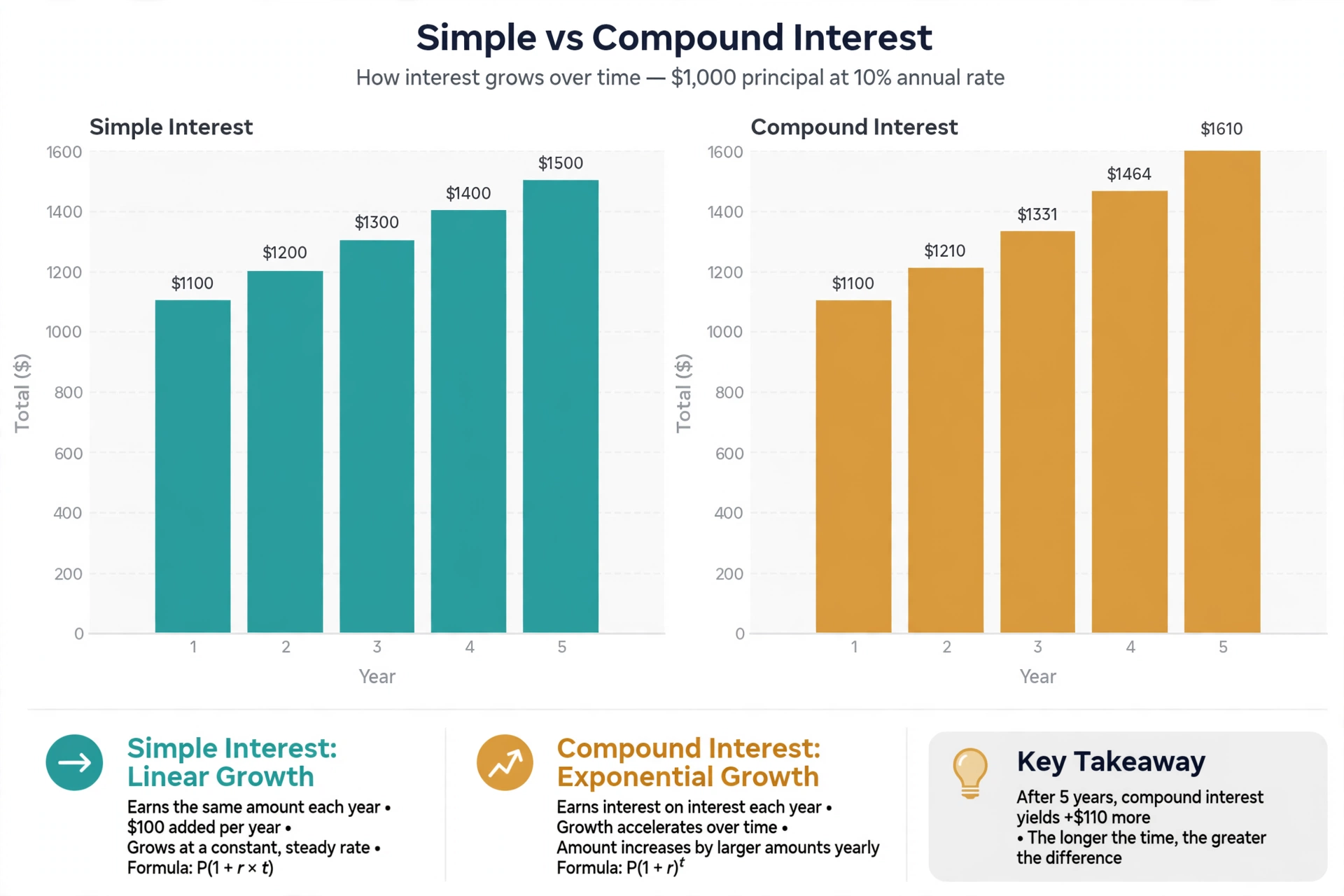
Compound interest is calculated on the principal plus any interest already earned. Each period, the base grows, so the interest grows too.
Worked example: Same $1,000 at 5%, compounded annually for 3 years.
Year 1: $1,000 × 0.05 = $50.00 → balance $1,050.00
Year 2: $1,050 × 0.05 = $52.50 → balance $1,102.50
Year 3: $1,102.50 × 0.05 = $55.13 → balance $1,157.63
Total interest = $157.63 — $7.63 more than simple interest.
Side by Side Over Time
| After… | Simple interest total | Compound interest total | Difference |
|---|---|---|---|
| 3 years | $1,150.00 | $1,157.63 | $7.63 |
| 10 years | $1,500.00 | $1,628.89 | $128.89 |
| 20 years | $2,000.00 | $2,653.30 | $653.30 |
| 30 years | $2,500.00 | $4,321.94 | $1,821.94 |
Over short times the difference is pocket change; over 30 years, compounding produces nearly 73% more on the same deposit.
Where You’ll Meet These in Real Life
Simple interest shows up in some short-term loans and certain bonds. Compound interest is standard for savings accounts, credit cards, and mortgages. On savings, compounding works in your favor. On credit card debt, which often compounds daily at high rates, it works against you — fast.
Whenever anyone quotes you an interest figure, ask: Is this simple or compound? and How often does it compound?
For the broader toolkit, the Everyday Money Calculator Guide has percentages, discounts, and bill-splitting all in one place.
Frequently Asked Questions
Is compound interest always better?
If you’re saving, compound grows your money faster — better for you. If you’re borrowing, compound grows what you owe faster — worse for you. The math is neutral; who benefits depends on whether you’re the lender or borrower.
What’s the difference between APR and APY?
APR is the basic yearly rate before compounding. APY includes compounding’s effect — it’s the "true" yearly growth and the better number for comparing savings accounts.
Why is the 3-year difference only $7.63?
Compounding is slow to start but powerful over time. The 30-year row shows a $1,821.94 difference on the same $1,000. Time is the fuel.
Can simple interest ever beat compound interest?
At the same rate and time, no. But a simple-interest product at 6% beats a compound one at 4%. Always compare actual numbers, not just the type.
The Bottom Line
Simple interest = interest on the original amount only. Compound interest = interest on the original plus all previously earned interest. Short term: pocket change difference. Long term: the whole game.
Related guides
- The Everyday Money Calculator Guide: Percentages, Discounts & Splitting Bills Without the Headache
- How to Set a Savings Goal and Actually Track It Monthly
How this guide was made: This guide was written by the ArmTema team, checked against standard reference formulas, and edited for plain-English clarity. The examples use round sample numbers so you can follow the math. Last reviewed: October 2026.