
You got a raise — congratulations. Then comes the question: how big is it, really? A $3,000 raise on a $90,000 salary (3.3%) versus a $40,000 salary (7.5%) — the dollar amount only tells half the story. The percentage tells you the rest.
The Formula
Raise percentage = (raise amount ÷ old salary) × 100
- Find the raise amount: new salary − old salary.
- Divide by your old salary.
- Multiply by 100.
If percentages feel shaky, our guide on how to calculate a percentage covers the mechanics.
Worked Example: $50,000 to $52,500
Step 1: $52,500 − $50,000 = $2,500
Step 2: $2,500 ÷ $50,000 = 0.05
Step 3: 0.05 × 100 = 5%
Your raise is 5%.
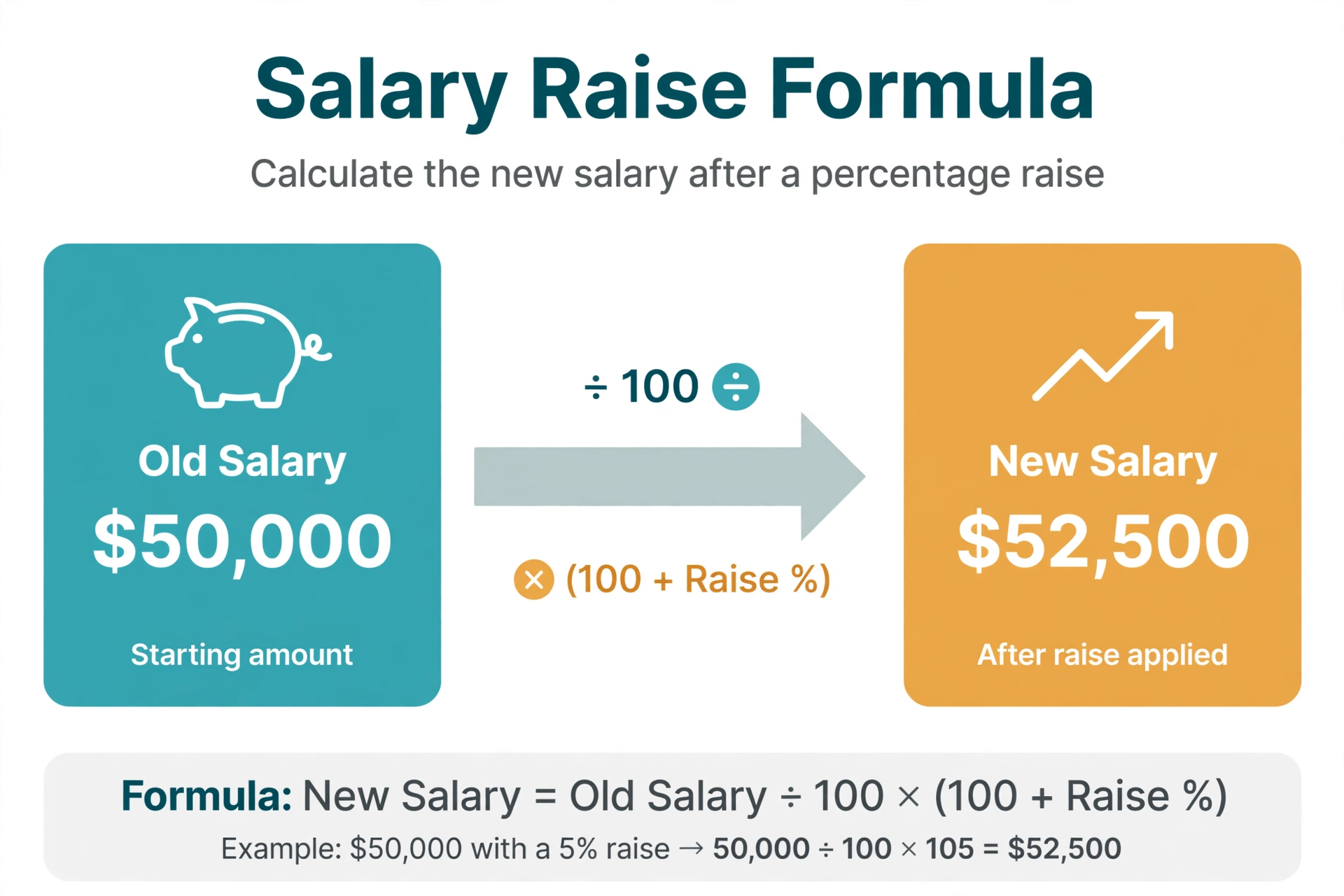
Working It Backwards: What’s My New Salary?
New salary = old salary × (1 + raise as a decimal)
Example: $58,000 with a 4% raise: $58,000 × 1.04 = $60,320.
Comparing Two Offers Fairly
A bigger dollar raise isn’t always the better deal. Consider benefits, cost of living, and growth path — the percentage keeps the salary part honest.
If you’re converting hourly figures while comparing, our hourly wage to yearly salary guide walks through that conversion.
What Does a "Good" Raise Look Like?
Context, not promises: matching inflation (~3%) keeps purchasing power level; above inflation means real growth; below inflation is a quiet pay cut. Promotions are a different category entirely.
Frequently Asked Questions
How do I calculate a raise percentage in my head?
10% of $50,000 is $5,000 (move the decimal). 5% is half: $2,500. Compare your raise to those landmarks.
What’s the formula with only old and new salaries?
((new − old) ÷ old) × 100. Same formula.
Does it include bonuses?
Usually not — raise percentages are about base pay unless "total compensation" is specified.
How is a pay cut calculated?
Same way; the result is negative. $50,000 → $47,500 = −5%.
My raise was 2% but inflation was 4%?
Your purchasing power fell ~2%. That’s why the percentage matters more than the dollar amount.
The Bottom Line
Raise percentage = (raise ÷ old salary) × 100. The dollar amount tells you what changed; the percentage tells you what it means.
For more money math, the Everyday Money Calculator Guide covers it all.
Related guides
- Hourly Wage to Yearly Salary: How to Convert It
- How Overtime Pay Is Calculated (Plain-English Walkthrough)
How this guide was made: This guide was written by the ArmTema team, checked against standard reference formulas, and edited for plain-English clarity. The examples use round sample numbers so you can follow the math. Last reviewed: October 2026.