
The truth about 10,000: it was a marketing slogan
In the 1960s, a Japanese company launched one of the first commercial pedometers. Its name translated roughly to “the 10,000-steps meter.” Ten thousand was chosen because it sounded good — round, ambitious, memorable. It was a product name, not a scientific finding. The most famous fitness number in the world started life as ad copy.
Large population studies on daily steps keep finding the same shape: the biggest gains come from going from very little to some. Benefits rise steeply as people move from, say, 2,000 to 6,000–8,000 steps, then level off. There is no cliff at 10,000. The honest summary: more than you are doing now is good; somewhere around 7,000–8,000 captures most of the benefit; beyond that is bonus. This guide is general information, not medical advice.
First, find out where you actually are
Before setting any target, measure a normal week. Most phones already count steps — check your health app for the daily average. Do not change anything for a week; just observe. Typical real-world numbers:
- Under 3,000: a mostly desk-bound day — car to office chair to sofa.
- 3,000–5,000: some natural movement — errands, walking around the building.
- 5,000–7,000: an active-ish day without trying.
- 7,000+: you are already doing well.
Write down your average. That is your baseline, and every plan starts from the baseline — not from 10,000.
Set targets you can actually hit: worked examples
The rule: add a manageable chunk to your baseline, hold it for a couple of weeks, then add again. A jump of about 1,000–1,500 steps is the sweet spot. In time terms, 1,000 steps is roughly a 10-minute walk.
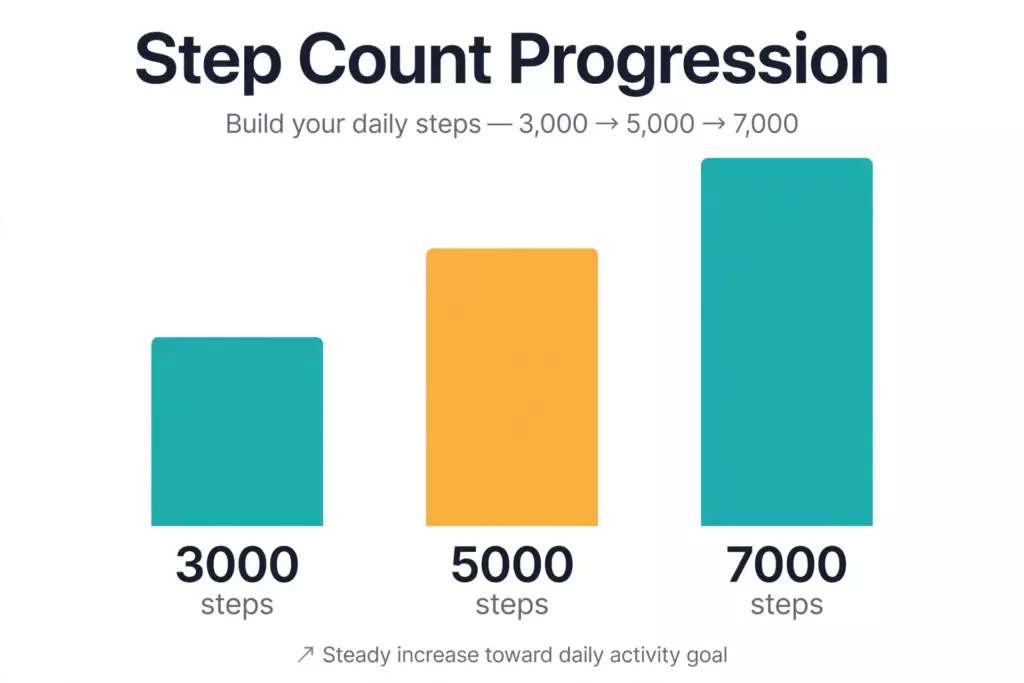
Example 1 — baseline 3,000 steps: Weeks 1–2: target 4,000–4,500 (one extra 10–15 minute walk). Weeks 3–4: target 5,500–6,000. Weeks 5–6: target 7,000. Three steps, six weeks, from 3,000 to 7,000 — no gym, no gear.
Example 2 — baseline 5,000 steps: Weeks 1–2: target 6,000–6,500. Weeks 3–4: target 7,500–8,000. Done — you are at the top of the useful range.
What counts (more than you think)
Your counter does not care about your outfit. All of this counts: walking to the shop instead of driving, taking stairs, pacing while on phone calls (long calls can quietly add 2,000 steps), housework, getting off the bus one stop early, a 10-minute walk after dinner. Most daily steps come from habit stacking, not workouts.
The traps to avoid
Trap 1: the all-or-nothing day. You check at 8 pm, see 4,000 against a 7,000 target, and think “failed.” But 4,000 beats your old 3,000 baseline by a third. Progress is a direction, not pass/fail. Trap 2: comparing with others. The only comparison that matters is you-last-month versus you-this-month. Trap 3: weekend collapse. A single 20-minute weekend walk each day smooths the whole week out. Trap 4: trusting the counter blindly. Phone counters are estimates — fine for tracking trends, but do not treat the exact number as gospel.
Frequently asked questions
Is 10,000 steps a day actually necessary? No. It was a 1960s marketing name for a pedometer. Research suggests most of the benefit accumulates by around 7,000–8,000 steps.
How many steps should a beginner aim for? About 1,000–1,500 more than your current average, held for two weeks, then raised again.
Do I need a fitness tracker, or is my phone enough? Your phone is enough for trend purposes. A dedicated device is only worth it if you want heart-rate data.
Does walking actually count as exercise? Yes — brisk walking counts as moderate activity in every major health guideline.
What if I cannot walk much due to health issues? Then step targets are not your game, and that is completely fine — talk to your doctor about what movement suits your situation.
This guide was written by the ArmTema team, checked against standard reference formulas, and edited for plain-English clarity. Last reviewed: October 2026.