
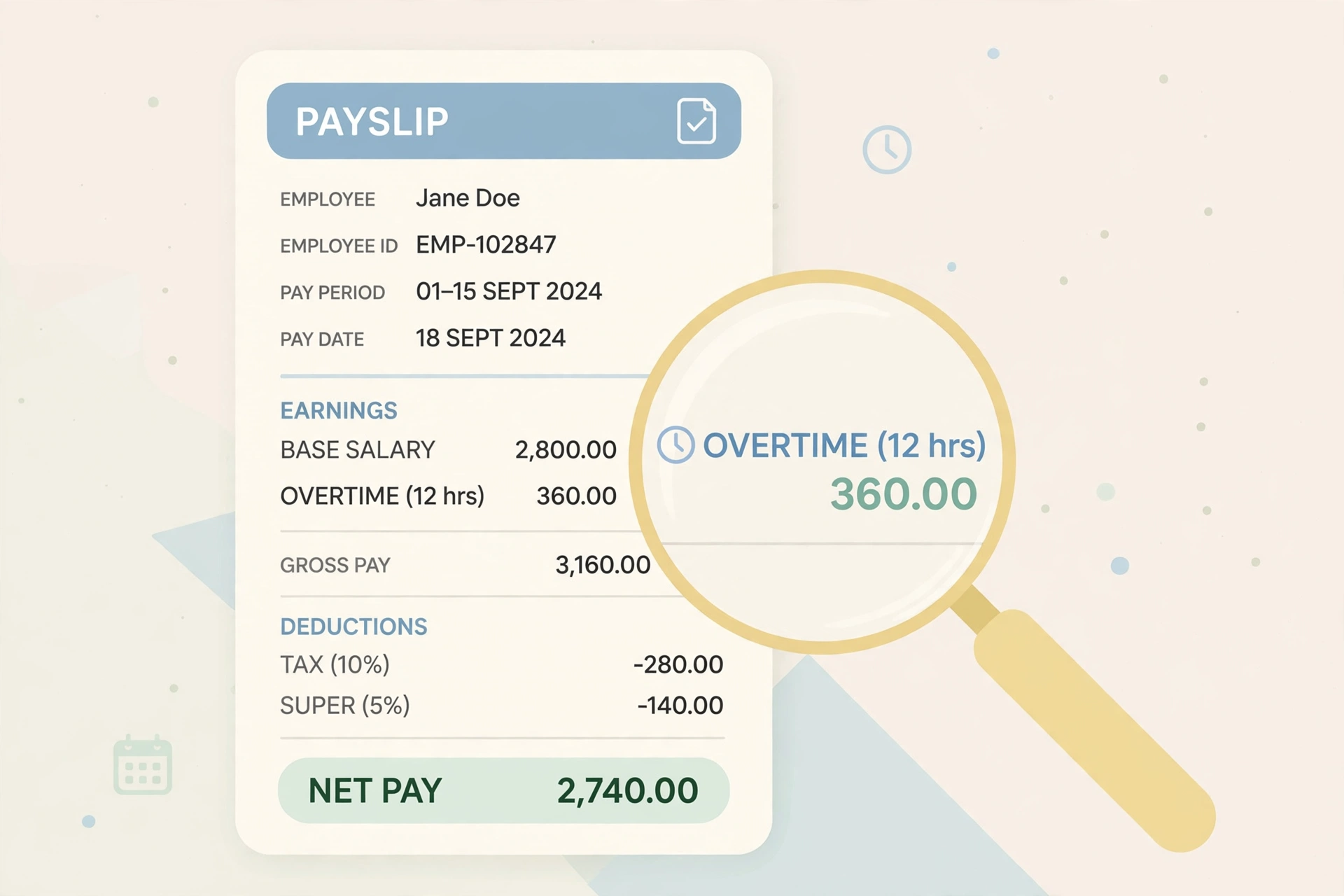
You open your payslip and there’s a line you can’t reproduce: “OT — 4.0 hrs” next to a number that looks almost, but not quite, like what you’d expect. Where did it come from? Why isn’t it just your hourly rate times four?
This guide walks through overtime pay the way it actually appears on a payslip — step by step, with one complete worked example. One important note up front: overtime rules differ by country, and sometimes by state, industry, or contract. The method below is the general concept; always check your local labor rules or your employment contract for the exact threshold and rate that apply to you.
What “overtime” actually means
Overtime means hours you worked beyond the standard full-time threshold for the pay period. In many places that’s 40 hours a week, but the threshold is set by labor law or your contract — not by this guide.
Two things decide your overtime pay, and both vary by where you work:
- The threshold — how many hours you must work before overtime kicks in.
- The rate — how much each overtime hour is worth compared to a normal hour.
Keep those two in mind. Everything below is just arithmetic built on top of them.
The most common pattern: time-and-a-half
In many countries, the standard overtime rate is 1.5 times your regular hourly wage — nicknamed “time-and-a-half.” At $20 an hour, each overtime hour pays $30.
I want to be straight with you: 1.5× is common, not universal. Some places require double pay for weekends or holidays. Some contracts set their own rates. Some roles are exempt entirely. The worked example below uses 1.5× because it’s the most widely recognized pattern — check your local rules to confirm what applies to you.
The walkthrough: a 44-hour week at $20 an hour
Here’s the whole calculation, exactly as it would appear on a payslip. Assumptions for this example: 40-hour threshold, 1.5× overtime rate.
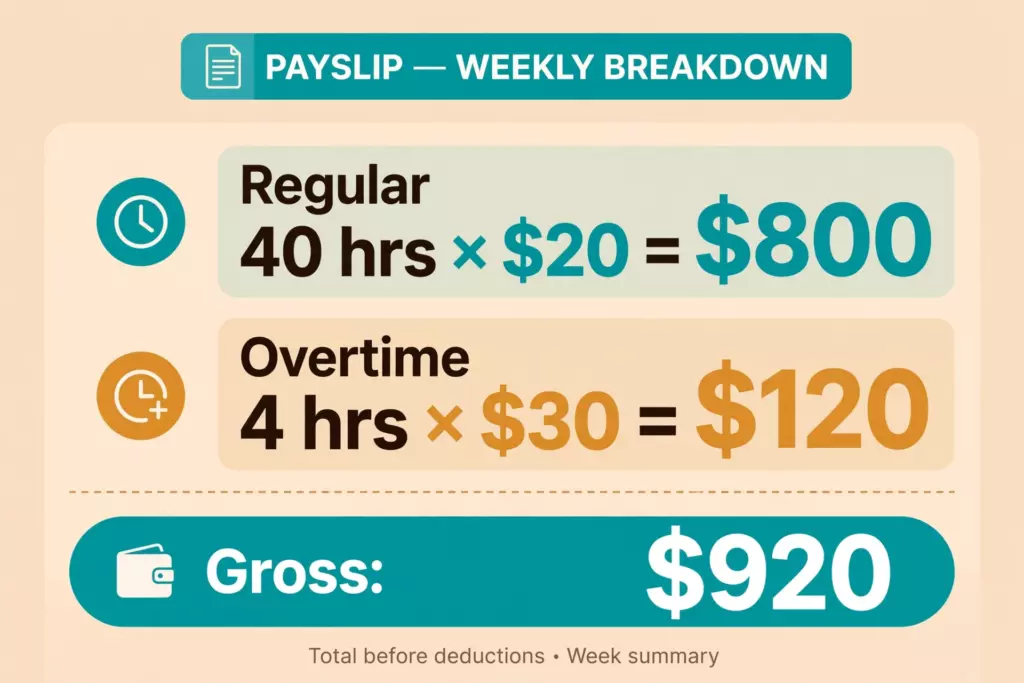
Step 1 — Regular pay:
40 hours × $20 = $800
Step 2 — Overtime rate:
$20 × 1.5 = $30 per overtime hour
Step 3 — Overtime pay:
4 overtime hours × $30 = $120
Step 4 — Gross pay for the week:
$800 + $120 = $920
That’s the full anatomy: two separate lines, two separate rates, one total. If your payslip shows “Regular: 40.0 hrs” and “OT: 4.0 hrs,” you can now reproduce both numbers with a pen.
Second example: the 48-hour week
Same $20 wage, busier week — 48 hours total. The method doesn’t change:
- Regular: 40 × $20 = $800
- Overtime rate: $20 × 1.5 = $30
- Overtime pay: 8 × $30 = $240
- Gross: $800 + $240 = $1,040
Notice the overtime line more than the extra hours suggest — that’s the 1.5× multiplier doing its work. Eight extra hours didn’t add $160 (8 × $20); they added $240. This is exactly why understanding your overtime rate matters: those extra hours are worth 50% more than they look.
How to read it on your payslip
Find the hours section of your payslip and look for two lines:
- Regular hours — your standard hours at your normal rate. Multiply them: hours × rate should equal the regular-pay line.
- OT / overtime hours — the extra hours at the higher rate. Multiply: OT hours × overtime rate should equal the overtime-pay line.
Add the two lines together — that should match your gross pay for the period. If a number doesn’t match, don’t assume the worst; payroll systems make data-entry mistakes too. Redo the math calmly, write it down, and ask payroll about the specific line. “My OT line shows $96 but 4 hours at $30 should be $120 — can you help me see what I’m missing?” gets better results than “my pay is wrong.”
When the pay period isn’t a week
Not everyone is paid weekly. If you’re paid every two weeks, the threshold usually doubles with it — for example, 80 straight-time hours per two-week period instead of 40 per week. Monthly pay works the same way, scaled up. The method is identical: regular hours at the regular rate, hours beyond the threshold at the overtime rate, added together.
One wrinkle to watch: with longer pay periods, a 44-hour week followed by a 36-hour week might average out to 80 hours with zero overtime — depending on how your local rules define the period. If that surprises you, your contract or local labor rules will explain which definition your employer uses.
Night, weekend, and holiday premiums
Some jobs add extra premiums on top of standard overtime — night shifts, weekends, or public holidays paid at higher multipliers (2× is common for holidays in many places, but again: local rules decide). The math works exactly the same way: premium hours × premium rate, as its own line on the payslip.
If your payslip shows three or four different hour-lines, don’t panic — just verify each line separately (hours × that line’s rate) and add them up. The method scales to any number of lines. And if a premium appears that nobody mentioned when you were hired, that’s a pleasant surprise worth confirming with payroll rather than assuming.
The part people get wrong
“Every extra hour counts as overtime.” Not necessarily. Only hours beyond your threshold qualify, and the threshold comes from local rules or your contract — not from how tired you feel on Friday.
“Overtime is always time-and-a-half.” Often, but not always. Weekend, night, and holiday premiums differ by place and contract. This is the single most common source of payslip surprises.
“Salaried workers never get overtime.” Depends entirely on the role and local rules. In some places many salaried roles are exempt; in others they’re not. Job title alone doesn’t settle it — the rules do.
“My overtime paycheck looked heavily taxed, so something’s off.” A bigger paycheck can have more withheld, which makes the net look smaller than expected. Withholding and tax rules differ by country, so the gross-pay math in this guide is the part you can verify yourself; for the tax side, check a local tax guide or ask payroll.
Frequently asked questions
Is overtime always paid at 1.5 times my wage?
It’s the most common pattern, but not a universal rule. Your employment contract or local labor law sets the actual rate — some places require double pay for certain hours, and some contracts differ.
How do I know which of my hours count as overtime?
Generally, hours worked beyond the standard full-time threshold in your pay period. The exact threshold comes from your local labor rules or contract, so that’s the document to check.
Do salaried employees get overtime?
It depends on the role and where you work. Many salaried roles are exempt from overtime in some places and not in others — your contract and local rules decide, not your job title alone.
Why does my overtime paycheck seem more heavily taxed than usual?
Withholding on a larger-than-usual paycheck can make the deductions look bigger. Tax and withholding rules differ by country, so for specifics check a local tax guide or ask your payroll department.
What should I do if my overtime pay looks wrong?
Redo the math yourself first — regular hours × rate, plus OT hours × OT rate — then take your written numbers to payroll and ask about the specific line. Calm arithmetic resolves most payslip mysteries.
How this guide was made
This guide was written by the Armtema team to explain the general concept of overtime calculation in plain English. The worked example uses sample numbers and the widely recognized 1.5× pattern purely to demonstrate the method — it is not legal, tax, or employment advice, and real thresholds and rates must be confirmed against your local labor rules or contract. Last reviewed: October 2026.