

Three moments from real life. You’re booking flights and need to know if the trip is 9 days or 10. You’ve just resigned and the contract says “30 days’ notice” — when exactly is your last day? There’s a wedding in December and someone asks “how long now?” and you genuinely have no idea.
All three are the same question: how many days sit between two dates? And nearly everyone gets the answer wrong by exactly one day. Here’s how to get it right every time.
The off-by-one: where everyone goes wrong
Picture Monday to Friday. Quick — how many days is that?
If you said five, you’re counting every day including both ends. If you said four, you’re counting the gaps between them. Both answers are “right” for different questions, and that’s the entire problem. Nobody tells you which one they mean.
- Hotel nights: check in Monday, check out Friday → you pay for 4 nights. The checkout day doesn’t count.
- “I’ll be away Monday to Friday” → most people hear 5 days of being away, both ends included.
- A 7-day free trial starting Monday → it ends Sunday, which is 7 days later, not 8.
So before you calculate anything, ask the one clarifying question: am I counting the start day, the end day, both, or neither? For trips, deadlines and notice periods, the standard is: count the end date, don’t count the start date. In other words, plain subtraction: end date minus start date.
The method: subtract, then adjust
The base calculation is simple: later date minus earlier date = days between them, with the start day not counted. Then adjust up or down by one depending on your situation.
Do it month by month when the dates span months: count the remaining days in the first month, add the full months in between, add the days in the final month.
Let’s run three real scenarios.
Scenario 1: how long is the trip?
You land on 3 July and fly home on 10 July.
10 − 3 = 7 days. That’s 7 full days of trip — and if you’re booking a hotel, 7 nights (you sleep there the nights of the 3rd through the 9th, and leave on the 10th).
This is the case where the simple subtraction is the whole answer. Trip length = checkout date minus check-in date. It works for car rentals, holiday cottages, and visa “days of stay” counts too.
Scenario 2: the 30-day notice period
Your contract says 30 days’ notice. You hand it in on 5 May. When’s your last day?
Count 30 days forward from 5 May, not counting the 5th itself. May has 31 days, so there are 31 − 5 = 26 days left in May after the 5th. You need 4 more to reach 30, which takes you to 4 June.
Your last working day is 4 June — assuming “30 days” means 30 calendar days. One warning: some contracts say “30 working days,” which skips weekends and holidays and stretches the answer out. If the wording says “working” or “business” days, count only Monday to Friday. When in doubt, ask HR — this is exactly the kind of thing worth one clarifying email.
Scenario 3: the countdown
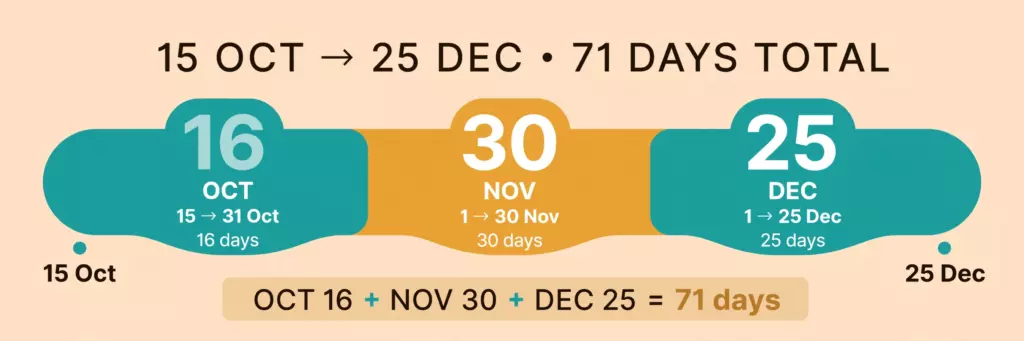
Today is 15 October. The wedding is 25 December. How long to wait?
Count what’s left of October: 31 − 15 = 16 days. Add all of November: 30 days. Add the December days up to the wedding: 25. Total: 16 + 30 + 25 = 71 days.
Notice we didn’t count today — a countdown measures complete days remaining. If someone asks “how many days until Christmas?” on the morning of 24 December, the answer is 1, not 2. Today never counts in a countdown.
When months and leap years complicate things
Going month by month handles the uneven months automatically — you just need each month’s length right. The only real trap is February: 28 days normally, 29 in a leap year. And leap years only matter if 29 February actually falls inside your date range. Counting from 1 March 2026 to 1 March 2027? No leap day inside (2026 isn’t a leap year, and the next Feb 29 is 2028) — it’s 365 days, plain and simple.
Cheat sheet: quick rules that cover 95% of cases
- Trip or hotel nights: checkout date minus check-in date. That’s your number.
- “Within 30 days”: usually means 30 days after the starting day, not including it — but check the exact wording on anything legal.
- Countdowns: never count today. Days remaining = event date minus today.
- Deadlines (“by 20 November”): the 20th itself still counts — you have until the end of that day.
- If two calculators disagree: one is counting inclusively (both ends) and the other exclusively. Now you know which is which.
Frequently asked questions
My trip runs Monday to Sunday. Is that 7 days or 8?
Count it as 7 calendar days (Monday through Sunday inclusive) — that’s why people call it a “week-long trip.” But the number that matters for money is nights: if you arrive Monday and leave Sunday morning, you sleep there Monday through Saturday night, which is 6 nights. Whenever a booking or a bill is involved, convert everything to nights and the confusion disappears.
Do weekends count in a notice period?
Calendar days include weekends unless your contract specifically says “working days” or “business” days. Most standard notice periods are calendar days, so a 30-day notice handed in on a Friday still ticks through the weekend.
Why does my phone’s calculator give a different number than my manual count?
Almost always the inclusive/exclusive difference. Many date calculators exclude the start date (giving you the subtraction answer); if you counted both end days by hand, you’ll be exactly one higher. Neither is wrong — they just answered slightly different questions.
How do I count days across a leap year?
Only February 29th matters, and only if it sits between your two dates. Going from January 2028 to March 2028? That’s 60 days (31 in January + 29 in February), not 59. Any other year, February behaves like a normal 28-day month.
What’s the fastest way to do this without a calculator?
For dates within the same month, just subtract. Across months, count “rest of this month + full months + days in the last month” — three small numbers, easy to do in your head. Or use the Days Between Dates tab in our homepage tool hub and let it do the month-length bookkeeping for you.
How this guide was made
This guide was written by the Armtema team and edited for plain-English clarity. Every worked example — the July trip, the May notice period, the October-to-December countdown — was calculated by hand twice, month by month, and cross-checked with a calendar, including the 2028 leap-year note. No example uses real personal dates. Last reviewed: October 2026.