
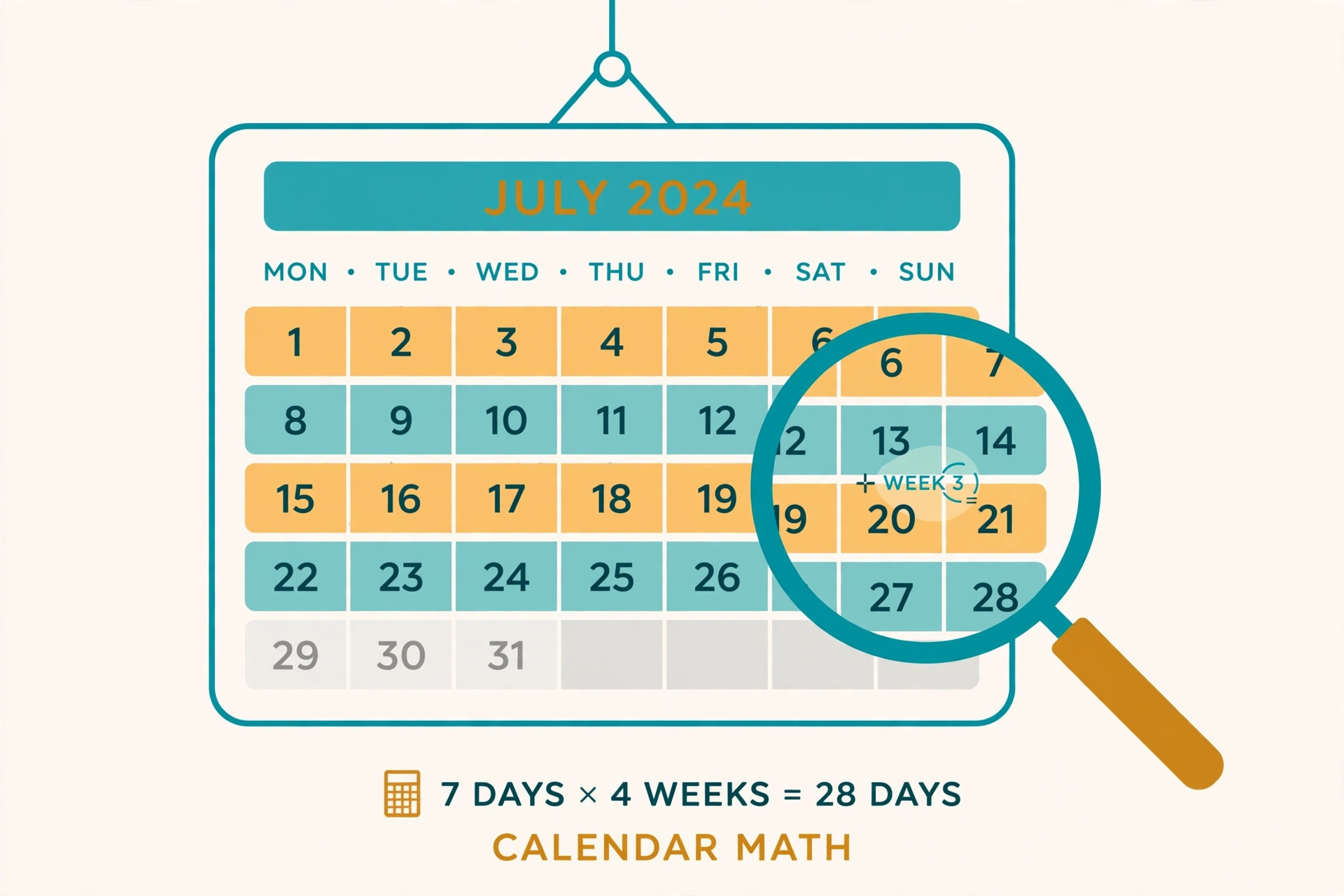
Quick: how many weeks in a month? If you said four, you’re wrong. Four weeks is 28 days, but most months have 30–31. That gap causes real confusion in budgets, payroll, and plans.
For more date math, see our age, dates and countdowns guide.
Why “4 Weeks = a Month” Is Wrong
- 4 weeks = 28 days = one February (non-leap)
- January: 31 days = 4 weeks plus 3 days
- Average month: 365 ÷ 12 = 30.44 days = 4.35 weeks
Why it matters: a subscription billed “every 4 weeks” charges 13×/year; “monthly” is 12×. Always check which a contract means.
52 Weeks in a Year
365 ÷ 7 = 52.14 → 52 full weeks plus 1 day (2 in leap years). That’s why birthdays shift weekdays yearly.
Worked Example: Weeks in 6 Months?
Wrong: 6 × 4 = 24 weeks. Right: 6 × 30.44 = 182.6 days ÷ 7 = 26 weeks. Two whole weeks difference — enough to derail a plan.

Quarters Explained
Q1: Jan–Mar, Q2: Apr–Jun, Q3: Jul–Sep, Q4: Oct–Dec. Each ≈ 13 weeks. Businesses report quarterly because 3 months is long enough to see trends, short enough to change course.
Payroll Trap: Monthly vs Four-Weekly Pay
- Monthly: 12 paychecks, each 1/12 of salary.
- Four-weekly: 13 paychecks, each 1/13 — smaller individually, with an “extra” one yearly.
Budget conversion: $100/week = 100 × 52 ÷ 12 = $433/month (not $400). That $33 is the “4 weeks = month” error in dollars.
Frequently Asked Questions
How many weeks in a school year? Typically 36–40 teaching weeks depending on country.
What does “fortnight” mean? Two weeks, exactly 14 days.
How many pay periods yearly? Monthly 12, four-weekly 13, fortnightly 26, weekly 52, twice-monthly 24.
How this guide was made
Related guides
- Age, Dates & Countdowns: Every Date Calculation Explained Simply
- How Many Days Between Two Dates (and Why You’d Need to Know)
How this guide was made: This guide was written by the ArmTema team, checked against standard reference formulas, and edited for plain-English clarity. The examples use round sample numbers so you can follow the math. Last reviewed: October 2026.