
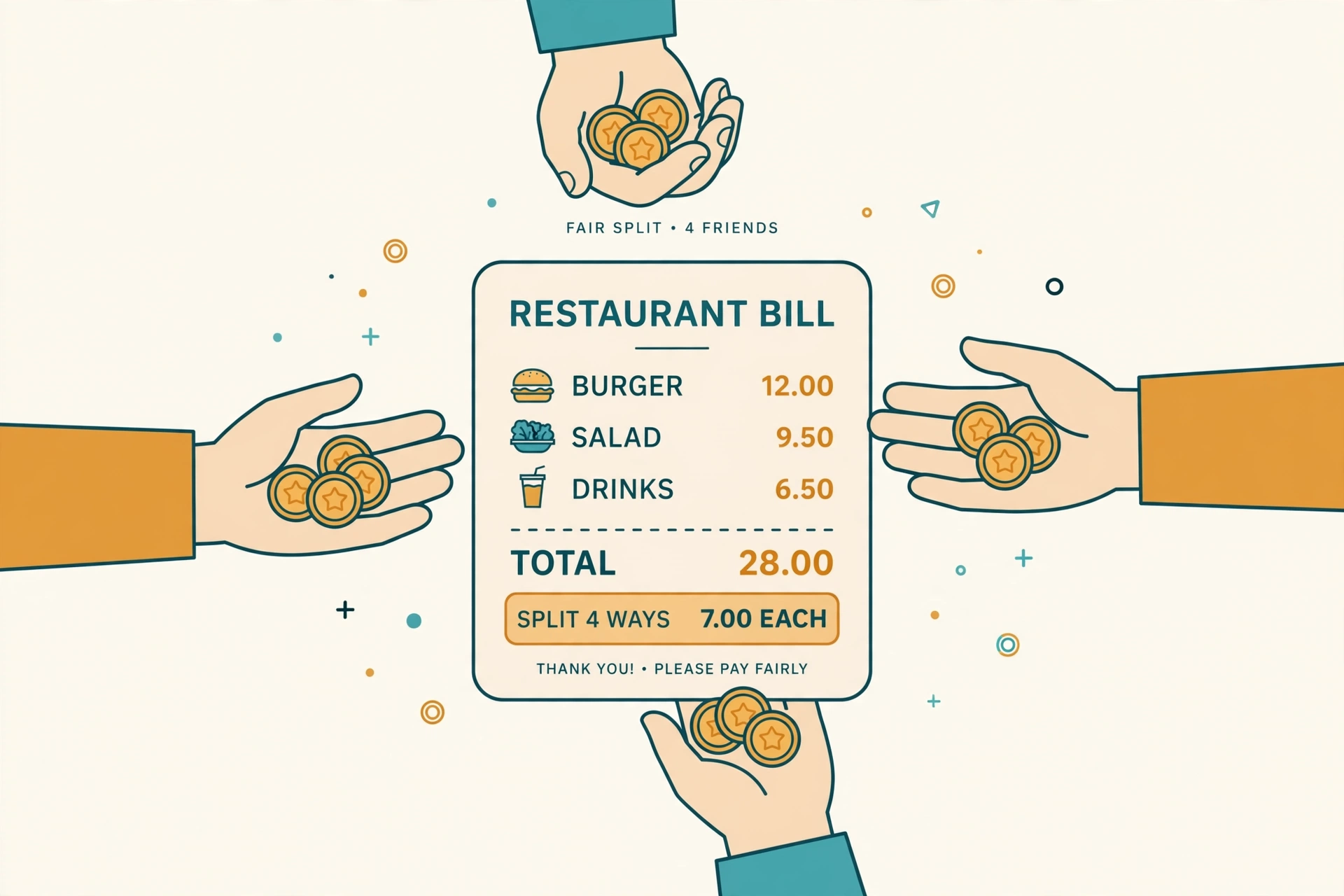
Splitting a bill is one of those small moments that can feel strangely tense. Everyone’s had a good time, the plates are cleared, and then the bill lands in the middle of the table like a pop quiz nobody studied for. Somebody reaches for their phone calculator. Somebody else says "just split it evenly" a little too fast. And at least one person is quietly wondering whether they should pay less because they only had a salad.
It doesn’t have to be like that. Splitting a bill fairly is just a bit of arithmetic plus a little honesty about what everyone ordered. Here’s how to do it without the awkwardness — tax and tip included.
The Even Split: Simple and Usually Fine
The most common method is the simplest: take the total bill (after tax and tip), divide it by the number of people, and everyone pays that amount.
Even split = total bill ÷ number of people
This works well when everyone ordered roughly similar things — a main dish each, a couple of shared appetizers, drinks all around. If your group is like this, the even split is the answer. Don’t overthink it. The few dollars of difference between who had the chicken and who had the pasta aren’t worth an itemized audit of the evening.
The even split stops being fair when one person’s order looks very different from everyone else’s. If three people had steak and wine and one person had soup and water, splitting evenly means the soup person is subsidizing everyone else’s dinner. That’s when you want the itemized approach (more on that below).
Adding Tax and Tip Before You Split
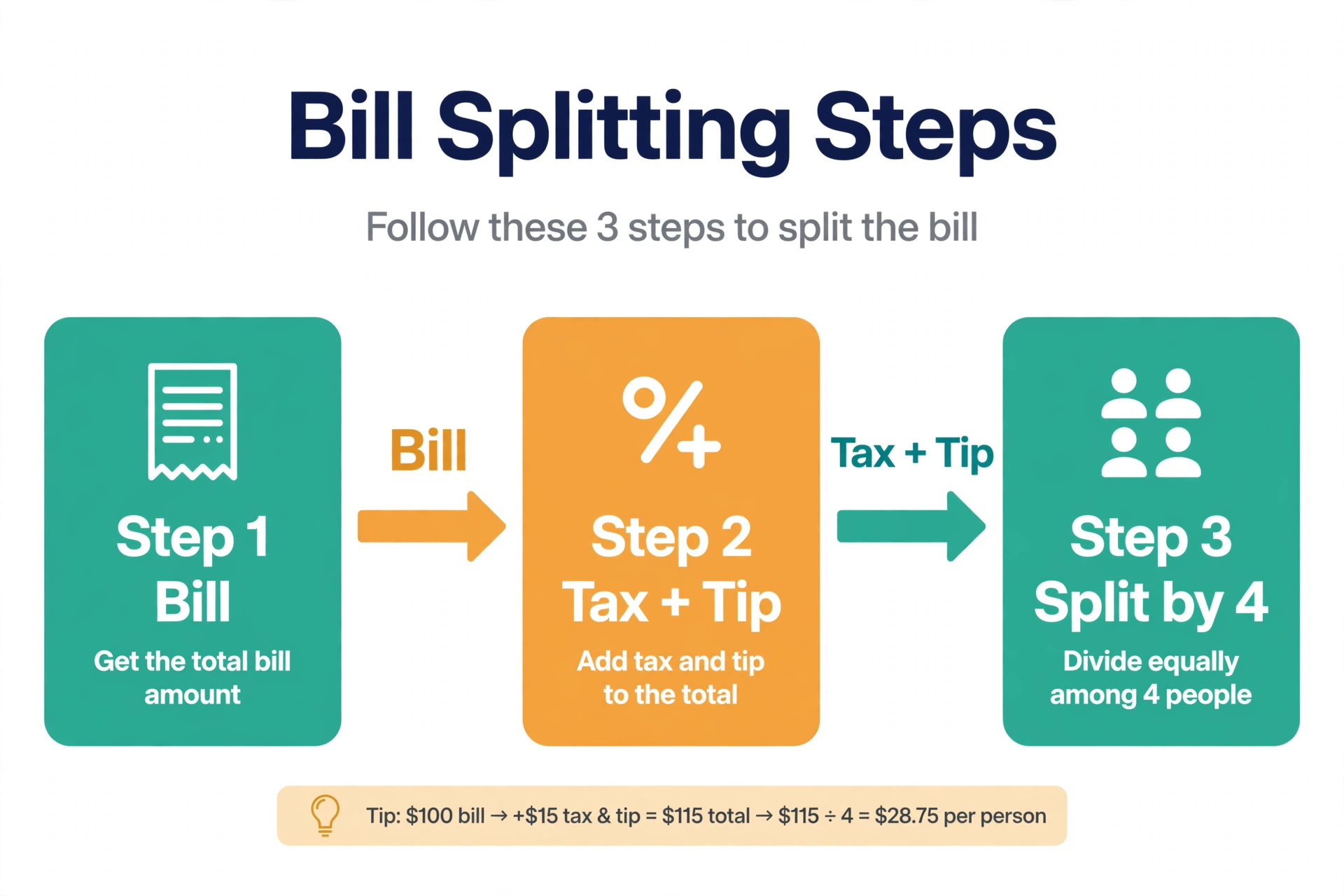
A lot of bill-splitting arguments happen because people split the food total and then argue about the tax and tip separately. Do it in the right order instead:
- Start with the food and drink total (the subtotal).
- Add the tax. The tax is usually printed on the bill. Just add it to the subtotal.
- Add the tip. Calculate the tip on the subtotal (before tax — that’s the standard in the US and many other places, though customs differ by country).
- Now split the grand total.
Grand total = subtotal + tax + tip
Everyone’s share = grand total ÷ number of people
The key insight: tip and tax are shared costs, just like the food. Splitting the final total automatically splits them fairly. Nobody needs to calculate their personal tax contribution.
If you’re unsure how much to tip in the first place, our guide on how much should you tip walks through the usual percentages for restaurants, delivery, and more.
Worked Example: A $120 Bill Among 4 People
Let’s walk through a real example so you can see every step.
Four friends have dinner. The food and drinks come to $120. The local sales tax is 8%, and they agree on an 18% tip.
Step 1: Calculate the tax.
$120 × 8% = $120 × 0.08 = $9.60
Step 2: Calculate the tip (on the subtotal, before tax).
$120 × 18% = $120 × 0.18 = $21.60
Step 3: Add it all up.
$120.00 (food) + $9.60 (tax) + $21.60 (tip) = $151.20
Step 4: Split it four ways.
$151.20 ÷ 4 = $37.80 per person
So each person pays $37.80. Clean, fair, done in under a minute.
A handy shortcut: instead of adding tax and tip separately, you can multiply the subtotal by a combined factor. Here that’s 1 + 0.08 + 0.18 = 1.26. So $120 × 1.26 = $151.20. Same answer, one step. Our discount calculator guide uses the same kind of combined-percentage thinking for sale prices — the math muscle is the same.
When Someone Ordered More: The Itemized Split
Sometimes the even split isn’t fair, and everyone knows it. The fix is the itemized split: each person pays for what they actually ordered, plus their share of the shared costs.
Here’s how:
- Each person totals their own items (their main, their drinks, their dessert).
- Shared items (appetizers, a bottle of wine for the table) get divided evenly among the people who shared them.
- Add tax and tip proportionally. The fair way: figure out each person’s share of the subtotal, then apply the same tax-plus-tip percentage to each person’s amount.
Let’s say the subtotal is $120, tax is $9.60, and tip is $21.60. The combined tax-and-tip rate is ($9.60 + $21.60) ÷ $120 = $31.20 ÷ $120 = 26%.
So if your items came to $25, you pay $25 × 1.26 = $31.50. If your friend’s items came to $40, they pay $40 × 1.26 = $50.40. Everyone’s tax and tip scales with what they ordered. Fair.
This sounds fiddly, but with a phone calculator it takes about two minutes. And it completely removes the quiet resentment of the person who ordered light.
The "One Person Pays" Method
There’s a third approach that’s popular with regular groups: one person puts the whole bill on their card, and everyone else sends them their share electronically.
This works best when the group eats together often, everyone trusts the payer to do the math honestly, and people are comfortable with payment apps or bank transfers.
The payer should still do the split calculation (even or itemized) and share the breakdown — a quick message like "Total was $151.20, so $37.80 each" keeps everything transparent.
Frequently Asked Questions
Should the tip be calculated before or after tax?
Before tax, in most places. The standard practice in the US is to tip on the pre-tax subtotal. Some other countries include service charges automatically or have different customs — when traveling, it’s worth a quick check of local norms.
What if someone didn’t drink alcohol but everyone else did?
The clean solution is the itemized split: the non-drinker pays for their food plus a share of non-alcohol shared items, and the drinkers split the alcohol among themselves.
Is it rude to ask for separate checks?
Not at all, especially in larger groups. Asking the server for separate checks at the start of the meal is the simplest solution — everyone pays exactly their own.
What about delivery orders split between roommates?
Same principles apply. Split the food total by what each person ordered, then divide the delivery fee, tax, and tip evenly (or proportionally to order size).
How do you handle it when someone "forgets" to pay?
A gentle reminder within a day or two is fine — most of the time it’s genuinely forgotten. A message like "Hey, just settling up from last night — your share was $37.80" works.
The Bottom Line
Fair bill-splitting comes down to three things: pick your method before the bill arrives, include tax and tip in the total before dividing, and match the method to the situation — even split for similar orders, itemized when they differ.
For more everyday money math, the Everyday Money Calculator Guide covers percentages, discounts, and the other calculations that come up at shops and restaurants.
Related guides
- How Much Should You Tip? A Simple Guide for Everyday Situations
- Discount Calculator: How to Find the Real Sale Price Fast
How this guide was made: This guide was written by the ArmTema team, checked against standard reference formulas, and edited for plain-English clarity. The examples use round sample numbers math. Last reviewed: October 2026.