

“40% OFF — TODAY ONLY!” The sign is bright red, the jacket looks great, and the original price tag says 3,200. But what’s the actual price? Standing in the aisle doing long multiplication in your head is nobody’s idea of fun — and stores count on that confusion.
Good news: finding a sale price takes about ten seconds once you know the two methods below. One of them is so fast you’ll wonder why nobody taught you this in school.
Method 1: find the discount, then subtract it
This is the step-by-step way, and it’s the clearest when you’re learning.
Take a 2,500 item with 20% off:
- Find 10% — move the decimal one place left → 250
- Double it for 20% → 500 (that’s your discount)
- Subtract from the original → 2,500 − 500 = 2,000
You pay 2,000. Three small steps, nothing harder than doubling a number.
Another one: headphones at 1,450 with 30% off. 10% → 145. Triple it → 435 discount. 1,450 − 435 = 1,015. That’s the real price hiding behind the red sign.
Method 2: calculate what you PAY (the faster one)
Here’s the shortcut the pros use. If something is 20% off, you aren’t paying 20% — you’re paying the other 80%. So skip the discount entirely and calculate 80% of the price directly.
Same example: 2,500 with 20% off → you pay 80%.
- 10% of 2,500 = 250
- 80% is eight of those → 8 × 250 = 2,000
One calculation instead of two. For 30% off, you pay 70%. For 15% off, you pay 85%. Just subtract the discount from 100 first, then work with that number.
This method really shines with friendly percentages. 25% off? You pay 75% — which is three quarters. A 1,600 item at 25% off: a quarter of 1,600 is 400, three quarters is 1,200. Five seconds, no sweat.
The 5-second shortcut for the most common sales
Most sale signs use the same handful of percentages. Memorize what you actually pay and you’ll barely need to calculate at all.
| Sign says | You pay | On 1,000 that’s |
|---|---|---|
| 10% off | 90% | 900 |
| 20% off | 80% | 800 |
| 25% off | 75% (three quarters) | 750 |
| 30% off | 70% | 700 |
| 40% off | 60% | 600 |
| 50% off | 50% (half) | 500 |
Read the sign, grab the “you pay” number, and scale it to the price tag. A 4,800 sofa at 40% off? You pay 60% — and 60% is just six 10% chunks: 6 × 480 = 2,880.
The stacked-discount trap (read this before the checkout)
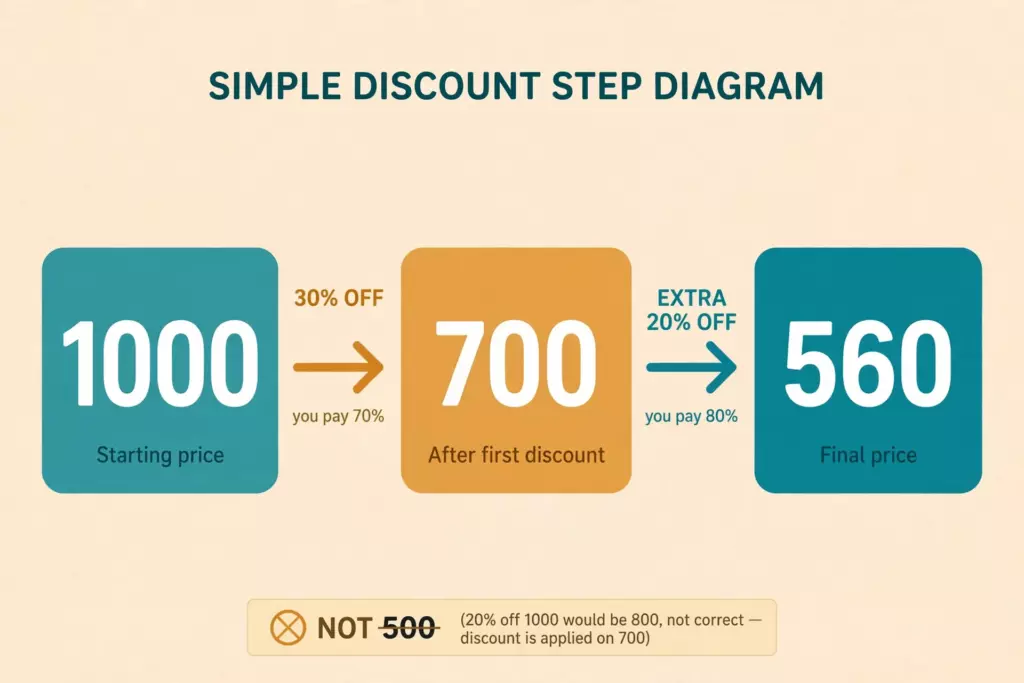
Here’s where stores get sneaky: “30% off, plus an extra 20% off at the register.” Most people add them up: 30 + 20 = 50% off. Wrong — and it’s not even close.
The second discount applies to the already reduced price, not the original. Watch:
- Start: 1,000
- 30% off → you pay 70% → 700
- Extra 20% off the 700 → you pay 80% of 700 → 560
Final price: 560. That’s a 44% total discount — not 50%. The store kept an extra 60, and most shoppers never notice.
The general rule for stacked discounts: multiply the “you pay” fractions. 30% off then 20% off → 0.70 × 0.80 = 0.56 → you pay 56% of the original. Two discounts of 25%? 0.75 × 0.75 = 0.5625 → you pay about 56%, meaning the real total discount is roughly 44%, not 50%.
Stacked discounts are still good deals — just smaller than they look. Now you know exactly how much smaller.
The full checkout: discount first, then tax
One more real-world wrinkle: in most shops, the discount comes off first and tax is charged on the reduced price. Here’s the full journey of a 2,000 jacket at 25% off with 8% tax:
- Discount: 25% off → you pay 75% → 1,500
- Tax: 8% of 1,500 → 1% is 15, times 8 → 120
- You pay: 1,500 + 120 = 1,620
Here’s a curiosity worth knowing: the order doesn’t actually change the total. Tax-first would be 2,000 + 160 = 2,160, then 25% off → 1,620. Identical. Multiplication doesn’t care about order — 2,000 × 0.75 × 1.08 is the same as 2,000 × 1.08 × 0.75. So don’t let a cashier’s sequence confuse you; the math lands in the same place.
What does change the total is the tax rate itself — and those differ by place, so the 8% here is just an example. Swap in your local rate and the method works the same.
A quick sanity check before you buy
Sale excitement makes brains fuzzy, so do this 3-second estimate first: round the price and the discount to friendly numbers. A 2,349 item at 35% off? Call it 2,300 at about a third off → roughly 1,530. If the register (or your exact math) says something wildly different, recheck. Estimation catches the big mistakes; exact math can come second.
Estimation also protects you from retail’s oldest trick: the “WAS 5,000, NOW 3,000!” sign where the “was” price was inflated or never real. If a discount looks too good to be true, your 3-second estimate will usually confirm the suspicion.
And when the numbers are awkward — 17% off 1,349 — skip the heroics and use the Discount & Tip Calculator on our homepage. It shows the discount, the final price, and even splits it per person if you’re shopping with friends.
Frequently asked questions
How do you calculate 20% off a price quickly?
Find 10% by moving the decimal one place left, then double it — that’s your discount, and subtract it from the price. Or faster: calculate 80% of the price directly (eight 10% chunks). On 2,500, 20% off means you pay 2,000.
Is “30% off plus an extra 20% off” the same as 50% off?
No. The second discount applies to the reduced price, not the original. On 1,000: 30% off leaves 700, then 20% off that leaves 560 — a 44% total discount, not 50%. Multiply the “you pay” fractions (0.70 × 0.80 = 0.56) to get the real answer.
What is the fastest way to find a sale price in your head?
Use the “what you pay” method: subtract the discount from 100 and calculate that percentage of the price. For 25% off, you pay 75% (three quarters). For 50% off, just halve it. Round the price first for a 3-second estimate.
How do you calculate a discount when the percentage is odd, like 17%?
Break it into friendly chunks: 10% + 5% + 2% (two 1% chunks). On 1,349: 10% is 134.9, 5% is 67.45, 2% is about 27 — add them for roughly 229 off, so you pay about 1,120. For exact figures, use a calculator.
Do discounts apply before or after tax?
In most places, the discount comes off first and tax is calculated on the reduced price — which saves you a little extra. Rules differ by country and sometimes by store, so if it matters for a big purchase, check your local rules or ask at the till.
How this guide was made
This guide was written by the Armtema team and checked against standard arithmetic. The examples use round sample numbers so each step is easy to follow. Last reviewed: October 2026.