
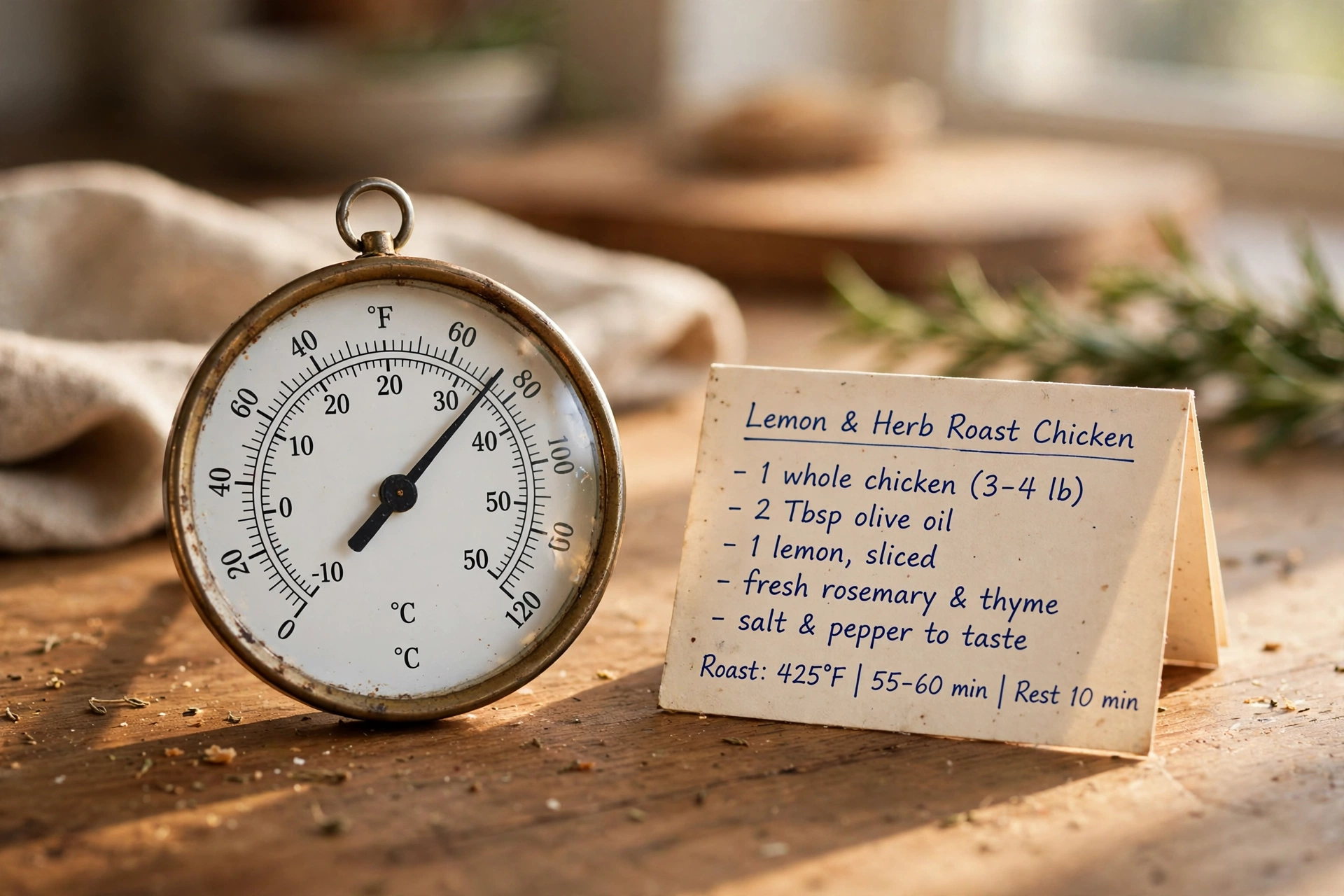
Your weather app says 68°F. You think in Celsius. Is that jacket weather or t-shirt weather? Or you’re following an American recipe and the oven needs to be 350°F — what does your Celsius oven dial say?
Temperature conversion has a reputation for being fiddly, but there’s a shortcut that gets you within a degree or two for everyday weather — and a dead-simple exact formula for when precision actually matters, like ovens and fevers.
The quick trick: double it and add 30
To go from Celsius to Fahrenheit, double the Celsius number and add 30.
- 20°C → 40 + 30 = 70°F (exact: 68°F — close enough for weather)
- 30°C → 60 + 30 = 90°F (exact: 86°F — a hot day either way)
- 10°C → 20 + 30 = 50°F (exact: 50°F — spot on)
- 0°C → 0 + 30 = 30°F (exact: 32°F — freezing, either way)
Why does this work? The real conversion multiplies by 1.8 and adds 32. Doubling (×2) is close to ×1.8, and 30 is close to 32 — so the shortcut shadows the real formula. It’s not magic, just friendly rounding.
This is genuinely all you need for: checking the weather abroad, chatting about temperatures with American friends, and deciding what to wear.
Where the trick breaks down (its limits)
No shortcut is perfect, and an honest guide says where the edges are. The double-and-add-30 trick drifts as temperatures get extreme:
- Body temperature: 37°C → trick says 104°F. Actual: 98.6°F. Off by more than 5 degrees — that’s the difference between “healthy” and “call a doctor.” Never use the shortcut for health.
- Deep cold: −20°C → trick says −10°F. Actual: −4°F. Off by 6.
- Oven heat: 200°C → trick says 430°F. Actual: 392°F. Off by nearly 40 — enough to burn dinner.
The rule of thumb: the shortcut is reliable roughly between −10°C and 35°C — the entire range of normal human weather. Outside that band (fevers, freezers, ovens), use the exact formula below.
Going back: subtract 30, then halve
Fahrenheit to Celsius is the mirror image: subtract 30, then divide by 2.
- 86°F → 86 − 30 = 56 → halved → 28°C (exact: 30°C — warm day, correct call)
- 68°F → 68 − 30 = 38 → halved → 19°C (exact: 20°C — light jacket weather)
- 32°F → 32 − 30 = 2 → halved → 1°C (exact: 0°C — freezing, right answer)
- 50°F → 50 − 30 = 20 → halved → 10°C (exact: 10°C — perfect)
Same limits apply in reverse: fine for weather, not for ovens or thermometers. Notice how the errors are small where it matters socially (“is it warm?”) and large where precision matters medically or culinarily. Convenient, really.
The exact formulas (for ovens, fevers, and science projects)
When close isn’t good enough, here are the real formulas. They’re simpler than they look:
- °F = (°C × 9 ÷ 5) + 32
- °C = (°F − 32) × 5 ÷ 9
In practice, ×9÷5 is the same as ×1.8, and ×5÷9 is the same as ×0.555… Most people just remember “times 1.8 plus 32” and “minus 32, times 0.56” — or let the homepage Unit Converter do it.
Three exact walkthroughs for the moments that matter:
The oven: Recipe says 350°F. (350 − 32) × 5 ÷ 9 = 318 × 5 ÷ 9 = 176.7°C → set your oven to 180°C. (Most ovens move in 10-degree steps anyway, so 175–180 is the honest answer.)
The fever check: Thermometer reads 100.4°F. (100.4 − 32) × 5 ÷ 9 = 38°C — that’s a fever. This is exactly the situation where the shortcut would have misled you, so use the real math or a converter. (General information only — if you’re worried about a fever, talk to a health professional.)
The freezer: Frozen food needs −18°C. (−18 × 9 ÷ 5) + 32 = −0.4°F — essentially 0°F, which is why American freezer dials bottom out at 0. Now you know why.
Six numbers worth memorizing
If you remember nothing else, these six anchor points let you estimate any temperature by feel.
| Celsius | Fahrenheit | What it feels like |
|---|---|---|
| 0°C | 32°F | Freezing — ice |
| 10°C | 50°F | Crisp — jacket needed |
| 20°C | 68°F | Pleasant room temperature |
| 30°C | 86°F | Hot summer day |
| 37°C | 98.6°F | Human body temperature |
| 100°C | 212°F | Boiling water |
Anything between two anchors, split the difference. 25°C sits between 20 and 30 → between 68 and 86 → about 77°F (exact: 77°F — the anchors rarely lie).

What about Kelvin? (the 30-second version)
You might have seen a third scale — Kelvin — in science class. Quick version: Kelvin is Celsius shifted so that zero means “as cold as physically possible.” To convert: add 273 to the Celsius number.
- 0°C (freezing) = 273 K
- 20°C (room temperature) = 293 K
- 100°C (boiling) = 373 K
Two quirks: there’s no “degrees” symbol — you say “293 kelvin,” not “293°K.” And you’ll never meet Kelvin on a weather app; it lives in laboratories and physics textbooks. Now you know enough to nod wisely if it comes up.
Why does America still use Fahrenheit, anyway?
Short answer: it got there first and never left. Daniel Fahrenheit built his scale in the early 1700s, and by the time the metric system arrived, generations of Americans were already thinking in Fahrenheit. The US never made the national switch the way most countries did.
There’s also a quiet logic to it: Fahrenheit was roughly designed around human experience — 0 was a bitterly cold winter day, 100 a scorching summer one. So the everyday weather range sits in a comfortable 0–100 band with no negatives needed. Celsius is more logical (water freezes at 0, boils at 100); Fahrenheit is arguably more human for weather. Both get the job done.
Frequently asked questions
What is the easiest way to convert Celsius to Fahrenheit in your head?
Double the Celsius number and add 30. 20°C becomes roughly 70°F (exact: 68°F). It’s accurate within a couple of degrees for everyday weather between about −10°C and 35°C — beyond that range, use the exact formula.
How do you convert Fahrenheit to Celsius without a calculator?
Subtract 30, then halve it. 86°F → 56 → 28°C (exact: 30°C). Like the forward trick, it’s a weather-range shortcut — fine for deciding what to wear, not for cooking or medical use.
What is 350°F in Celsius for an oven?
About 180°C. The exact conversion is 176.7°C, but ovens typically adjust in 10-degree steps, so 175–180°C is the practical answer. For baking, always use the exact formula or a converter rather than the mental shortcut.
Why is the double-and-add-30 trick not exact?
Because the real formula multiplies by 1.8 (not 2) and adds 32 (not 30). The shortcut rounds both numbers to friendlier ones, which introduces a small error that grows at extreme temperatures. Between −10°C and 35°C the error stays tiny.
What temperature is the same in Celsius and Fahrenheit?
−40°. It’s the one point where both scales meet: −40°C = −40°F. A fun fact for quizzes — and reassuringly, far outside any weather you’ll casually convert.
Is 72°F warm or cold?
Pleasantly warm — it’s about 22°C, typical comfortable room temperature. Using the reverse trick: 72 − 30 = 42, halved = 21°C (exact: 22.2°C). T-shirt weather indoors, light layer outdoors.
How this guide was made
This guide was written by the Armtema team using the standard temperature conversion formulas. The shortcut’s accuracy limits were checked by comparing it against exact values across the full range. Health-related examples are general information only, not medical advice. Last reviewed: October 2026.