

“$18 an hour.” Sounds fine — until someone asks what that works out to per year, and your brain goes blank. Or you’re comparing two job offers, one hourly and one salaried, and you genuinely can’t tell which pays more.
Good news: the conversion is one line of math, and once you’ve seen where the magic number comes from, you’ll never need to look it up again.
Where the number 2,080 comes from
A standard full-time year is:
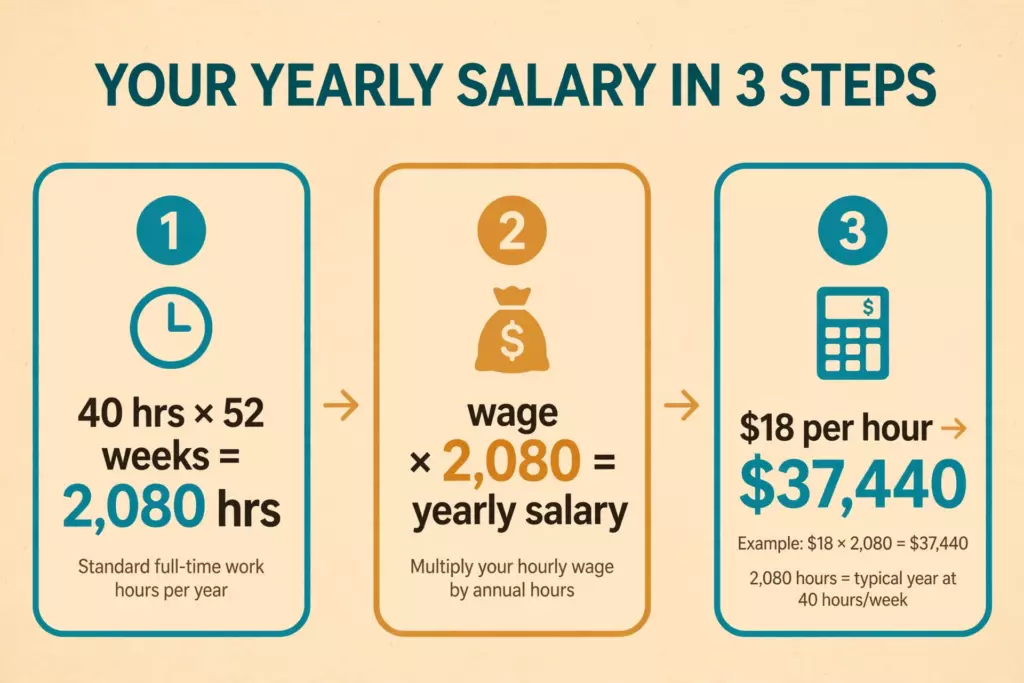
40 hours per week × 52 weeks = 2,080 hours.
That’s it. That’s the whole secret. Every hourly-to-salary conversion you’ve ever seen is just the hourly wage multiplied by 2,080. Now the formula:
Hourly wage × 2,080 = yearly salary.
The formula in action: $18 an hour
Let’s do it slowly, no calculator tricks:
- $18 × 2,000 = $36,000
- $18 × 80 = $1,440
- Total: $37,440 per year.
So $18 an hour, full-time, is $37,440 a year before tax. (About $720 a week, if you’re curious — $37,440 ÷ 52.)
The 10-second estimate
No calculator handy? Double your hourly wage and add three zeros: $18 → roughly $36,000. It’s not exact (the real answer was $37,440), but it gets you within spitting distance in a conversation. For a slightly better mental estimate, double the wage, add three zeros, then add 4% — $36,000 + ~$1,440 = $37,440. Close enough to make decisions with; use the real formula for anything official.
Working part-time? Just change the hours
The 2,080 figure assumes full-time. For anything else, swap in your real weekly hours:
Your weekly hours × 52 × your wage = your yearly pay.
Example: 25 hours a week at $18 an hour.
- 25 × 52 = 1,300 hours per year
- $18 × 1,300 = $23,400 per year.
Same method works for 30 hours, 20 hours, anything — the formula doesn’t care, it just needs your actual hours.
Common hourly rates at a glance (full-time)
| Hourly wage | Yearly salary |
|---|---|
| $15 | $31,200 |
| $18 | $37,440 |
| $20 | $41,600 |
| $25 | $52,000 |
| $30 | $62,400 |
Each row is just the wage × 2,080 — verify any of them by hand in seconds. Useful when a job ad lists one format and your brain thinks in the other.
Going backwards: salary to hourly
Sometimes the offer is the other way round. To turn a yearly salary into an hourly rate, divide by 2,080:
$38,000 ÷ 2,080 = $18.27 per hour.
Handy when a job ad says “$38,000 per annum” and you think in hours. (For part-time roles, divide by your yearly hours instead — e.g. $23,400 ÷ 1,300 = $18/hour, which checks out.)
Paid every two weeks? Divide by 26
Many employers pay biweekly — 26 paychecks a year. The math is the same shape:
$37,440 ÷ 26 = $1,440 per paycheck (gross, before tax).
Two things worth knowing about biweekly pay: first, twice a year you’ll get a magical third paycheck in a single month (26 paychecks don’t divide evenly into 12 months) — plan for it rather than spending it by surprise. Second, if you’re comparing a biweekly offer against a twice-monthly (24 paychecks) offer, compare the yearly totals, not the per-paycheck amounts — $1,440 × 26 and $1,560 × 24 are both $37,440, but the paycheck sizes look different — $1,440 × 26 and $1,560 × 24 are both $37,440, but the per-paycheck amounts differ.
What about monthly? Divide by 12
Yearly figures are abstract; monthly figures pay the rent. Take the yearly number and divide by 12:
$37,440 ÷ 12 = $3,120 per month (gross, before tax).
That’s the number to hold against your actual monthly costs. If your share of rent, bills, food, and transport comes to $2,400, a $3,120 gross monthly figure leaves real breathing room — before tax takes its bite, which is why the “before tax” warning below matters.
Don’t forget regular overtime in the comparison
Here’s where hourly offers often beat salary offers on paper: if the hourly job regularly includes overtime, that overtime belongs in your comparison. Say the $19/hour offer (base $39,520) typically includes 5 overtime hours a week at 1.5×:
- Overtime rate: $19 × 1.5 = $28.50/hour
- Yearly OT hours: 5 × 52 = 260 hours
- Overtime pay: 260 × $28.50 = $7,410
- Realistic yearly total: $39,520 + $7,410 = $46,930
Against the $38,000 salary, that’s not close anymore. But — and this matters — only count overtime you can reasonably expect. Occasional, unpredictable overtime shouldn’t anchor a decision; regular, scheduled overtime can. (And confirm the overtime rate in the offer — see the walkthrough linked below.)
Comparing two real offers
This is where the math earns its keep. Say you’re choosing between:
- Offer A: $19/hour, full-time → $19 × 2,080 = $39,520/year
- Offer B: $38,000/year salary
On base pay alone, Offer A is higher by $1,520 a year. That’s the math’s answer. The full decision also involves benefits, paid leave, overtime rules, and job security — things numbers alone can’t settle — but at least now you’re comparing real figures instead of guessing.
What this number leaves out (read this part)
The converted figure is useful but it’s gross pay before tax, and it comes with fine print:
- It’s before tax. Your take-home pay will be lower, and tax rules differ by country — sometimes a lot.
- It assumes 52 paid weeks. Unpaid time off, gaps between jobs, or seasonal work all shrink the real total.
- It excludes extras. Overtime, bonuses, tips, and commissions sit on top of this number, not inside it.
- Benefits have invisible value. Health cover, paid leave, and retirement contributions are worth real money that never appears in the hourly rate.
Use the conversion to compare and plan — just don’t mistake it for the exact number that’ll hit your bank account.
Frequently asked questions
Why 2,080 and not some other number?
Because 40 hours × 52 weeks = 2,080. It’s simply the number of hours in a standard full-time work year, which makes it the natural bridge between hourly and yearly figures.
How do I convert a salary back to an hourly rate?
Divide the yearly salary by 2,080 for full-time roles. For part-time, divide by your actual yearly hours (weekly hours × 52).
Does the converted salary include overtime pay?
No. The 2,080-hour method covers standard hours only. Overtime is calculated separately on top — see our plain-English overtime walkthrough for how that math works.
What if I work 37.5 hours a week instead of 40?
Adjust the hours: 37.5 × 52 = 1,950 hours per year. Multiply your wage by 1,950 instead of 2,080. Same method, your numbers.
Is the result my take-home pay?
No — it’s gross pay before tax and deductions. What you actually receive depends on your country’s tax rules, so treat the converted figure as a comparison tool, not a paycheck prediction.
How this guide was made
This guide was written by the Armtema team and checked against the standard full-time-hours calculation (40 hours × 52 weeks). The examples use round sample wages so every step of the math is visible and verifiable. It explains a calculation method, not financial or employment advice. Last reviewed: October 2026.