

Most budgeting advice fails for one simple reason: it asks you to track forty spending categories, update a spreadsheet daily, and feel guilty about a sandwich. Nobody keeps that up.
The 50/30/20 rule is the opposite. It splits your money into just three buckets, and once you understand the buckets, you can run your whole budget on the back of an envelope. This guide explains exactly how it works, with real numbers you can follow line by line.
The whole rule in one paragraph
Take your monthly take-home pay — what actually lands in your account after tax — and divide it three ways: 50% for needs (the bills that keep your life running), 30% for wants (the stuff that makes life enjoyable), and 20% for your future self (savings and extra debt payments). That’s it. Three numbers, one habit.
What actually goes in each bucket
The buckets sound obvious until you try sorting your own spending. Here’s how to draw the lines.
50% — Needs
These are the non-negotiables: rent or mortgage, groceries, transport to work, utilities, phone bill, insurance, and minimum payments on any debt. If skipping it would cause real problems within a month, it’s a need.
30% — Wants
Everything you enjoy but could survive without: eating out, streaming subscriptions, hobbies, clothes beyond the basics, the nicer phone plan. Wants aren’t bad — the rule gives them a full 30% on purpose. A budget with zero fun in it is a budget you’ll abandon by week three.
20% — Future you
Savings, your emergency fund, extra payments toward debt beyond the minimums, and retirement contributions. Think of it as paying your future self first, before the month’s spending gets a vote.
The gray areas: a gym membership is usually a want (unless a doctor told you to exercise). Your phone bill is a need, but the premium unlimited plan is a want wearing a need’s clothes. When in doubt, ask: “Would my life actually break without this?” If not, it’s a want.
A full example with real numbers: $2,000 take-home
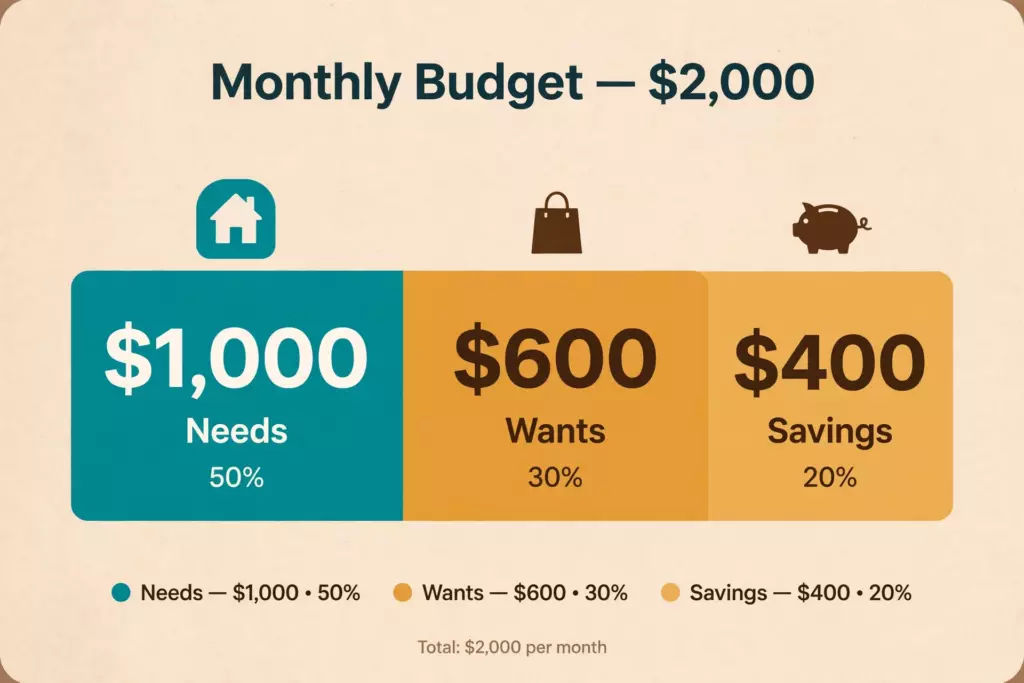
Let’s run the rule on a $2,000 monthly take-home pay. The buckets: $1,000 needs, $600 wants, $400 savings.
Needs — $1,000:
- Rent: $600
- Groceries: $220
- Transport: $120
- Phone and utility bills: $60
- Total: $1,000 ✓
Wants — $600:
- Eating out: $150
- Subscriptions (streaming, music): $40
- Hobbies: $120
- Clothes: $140
- Fun money: $150
- Total: $600 ✓
Future you — $400:
- Emergency fund: $250
- Savings goal (holiday, laptop, whatever’s next): $150
- Total: $400 ✓
$1,000 + $600 + $400 = $2,000. Every dollar has a job, and nothing is tracked beyond these three buckets. Notice the savings bucket gets filled on payday, not “with whatever’s left” — because whatever’s left is historically nothing.
A second example: $3,500 take-home
One example is nice; two makes the pattern click. Same rule, bigger paycheck — buckets of $1,750 / $1,050 / $700:
Needs — $1,750: rent $1,000, groceries $400, transport $200, bills $150 = $1,750 ✓
Wants — $1,050: dining out $250, subscriptions $60, hobbies $200, clothes $240, fun money $300 = $1,050 ✓
Future you — $700: emergency fund $400, savings goal $300 = $700 ✓
$1,750 + $1,050 + $700 = $3,500. Notice nothing about the method changed — only the numbers got bigger. That’s the whole appeal: learn it once on any income, and it scales with you.
“But my rent alone is half my pay” — the high-rent adjustment
Here’s the honest version: in expensive cities, the neat 50/30/20 split often doesn’t fit. If your rent is $900 on a $2,000 income, your needs might genuinely be 70% of your pay. That doesn’t mean the rule is useless — it means you adjust the ratios.
Same $2,000, high-rent version: 70/20/10.
- Needs: $1,400 (rent $900 + groceries $220 + transport $120 + bills $60 + minimums $140)
- Wants: $400
- Future you: $200
The point was never the exact numbers 50, 30, and 20. The point is the habit: split your money into three deliberate piles instead of spending until it’s gone. Use 50/30/20 as the starting target, bend it to fit your city, and revisit it when your rent or pay changes.
Three mistakes that quietly break the rule
1. Budgeting from your gross pay. The rule runs on take-home pay — what lands in your account. Budgeting from your pre-tax salary makes every bucket too big, and you’ll wonder why the math never works.
2. Promoting wants to needs. Daily takeout coffee, the premium tier of everything, a “need” for new shoes every month. Be honest for ten minutes when you first sort your spending; the rule only works if the buckets mean something.
3. Saving what’s left over. Flip it: move the 20% to savings on payday, then live on the rest. People who save first consistently end the month with savings. People who save “what’s left” consistently end the month with an explanation.
Your first 20 minutes with the rule
Reading about budgeting changes nothing; twenty focused minutes will. Grab your last month of bank or card statements and do this:
- Find your take-home number — the total that actually arrived, after tax. Write it at the top of a page.
- Multiply by 0.5, 0.3, and 0.2. Those are your three bucket targets. (On $2,400 take-home: $1,200 / $720 / $480.)
- Sort last month’s spending into needs, wants, and savings. Don’t judge it yet — just sort it.
- Compare. Where did you overshoot? Most people discover their wants bucket is really a 45% bucket wearing a 30% disguise. That gap is your starting point, not your verdict.
Do this once, and the rule stops being theory. Revisit the sort every few months or whenever your pay or rent changes — budgets are living documents, not stone tablets.
How the buckets shift as life changes
The 50/30/20 split is a starting point, not a life sentence. Different seasons call for different ratios, and that’s normal:
- Tight months (job change, new baby, surprise bills): 70/20/10 keeps the structure alive when 50/30/20 won’t fit. The 10% savings matters less for the amount than for keeping the habit unbroken.
- High-earning, low-expense stretches (living with family, no rent): flip it — 30/30/40. Banking 40% while your costs are low is how emergency funds get built in months instead of years.
- Debt payoff mode: temporarily run 50/20/30, with the 30% aimed at extra debt payments. Once the debt is gone, that 30% becomes savings without you changing a single habit.
The through-line: the buckets stay, the percentages flex. Anyone who tells you there’s one correct ratio for every human life is selling something.
Frequently asked questions
Is the 50/30/20 rule based on gross or take-home pay?
Take-home pay — the amount that actually reaches your account after tax and deductions. Percentages of your gross salary will overstate what you can spend and the budget will quietly fail.
Who came up with the 50/30/20 rule?
It was popularized by Elizabeth Warren and Amelia Warren Tyagi in their book All Your Worth. It’s a guideline that’s helped beginners for years, not a law of nature — adjust it to fit your life.
What if my rent alone is 50% of my income?
Then use a bent version of the rule, like 60/25/15 or 70/20/10, as shown above. Keeping the three-bucket structure matters far more than hitting the exact percentages.
Does the 20% savings bucket include paying off debt?
In the original framing, yes — extra debt payments beyond the minimums count as paying your future self. Minimum debt payments themselves sit in the 50% needs bucket, since skipping them causes real trouble.
What if my income changes every month?
Average your last three months of take-home pay and budget to that average. In better months, the surplus goes straight to the savings bucket instead of inflating your wants.
How this guide was made
This guide was written by the Armtema team and checked against the standard 50/30/20 budgeting method. The examples use round sample numbers so you can follow the math step by step — they’re illustrations of the method, not financial advice. Last reviewed: October 2026.